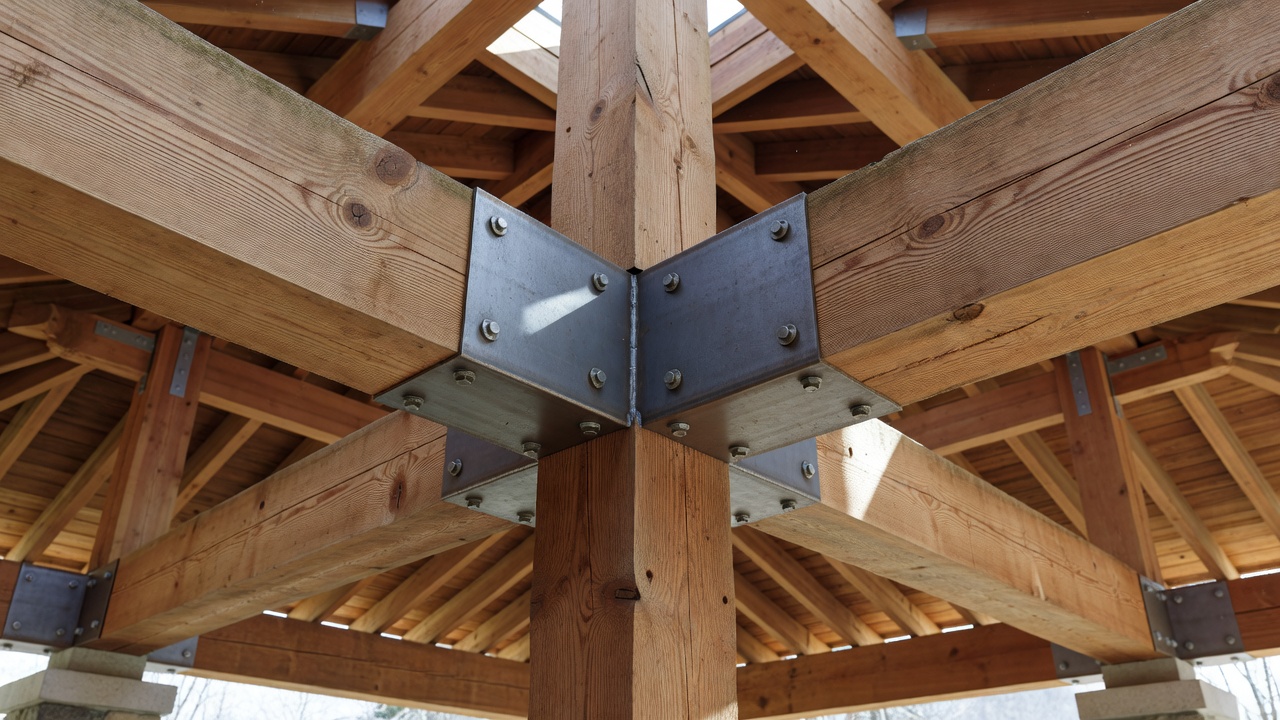
A joint is an argument about behavior
Look at the point where a slender roof meets its support. A thick plate may be spreading force across a softer material. A slot may allow movement, although its purpose cannot be confirmed without drawings. A visible gap may keep timber away from standing water. Each observation is useful, but none should become a confident technical conclusion from a photograph alone.
For design students, this distinction is essential: describe first, interpret second, verify third. Draw the visible components, mark the probable load direction, then list what remains unknown. Hidden fixings, fire protection and drainage routes can change the entire reading. A pavilion's apparent simplicity often depends on carefully resolved work that the visitor never sees.
Timber: grain, layers and exposure
Timber is not one uniform substance. Species, grading, moisture content and engineered layups influence its behavior. Glued laminated members can make long or curved elements possible, while panel systems distribute loads differently. At a connection, forces perpendicular to the grain deserve particular attention because timber does not behave identically in every direction.
The 2005 Serpentine Pavilion by Álvaro Siza and Eduardo Souto de Moura, with engineering by Arup, is a useful reference for studying a timber grid as an architectural field. Rather than copying its appearance, ask how repeated members establish rhythm and how connections let that rhythm continue. Weather protection and end-grain detailing remain relevant even when the overall form is expressive.
Steel: thinness has supporting conditions
A steel edge can look remarkably slight, but visual thinness is not the same as structural effortlessness. Buckling, connection stiffness, corrosion protection and fabrication tolerances all matter. A broad plate seen face-on may almost disappear when viewed edge-on. Sketching both views helps separate an optical effect from a structural one.
In Sou Fujimoto's 2013 Serpentine Pavilion, a lattice of slender steel elements created a cloudlike spatial presence. The example encourages a question beyond “how thin is it?”: how do many small members work together, and where does the visitor encounter the resulting density? Welded repetition can produce continuity, but bolted assemblies may offer different possibilities for maintenance and disassembly. Neither connection is universally preferable.
Membranes: shape is part of the structure
A tensioned membrane does not work like a rigid sheet laid across beams. Its geometry, prestress and edge restraint are integral to its behavior. High and low points guide both force and water. Seams, reinforced corners, cables and anchors deserve as much attention as the sweeping surface between them.
Frei Otto's work offers an important lineage for this way of thinking. His lightweight experiments treated form as the outcome of forces and material behavior rather than an arbitrary silhouette. Different membrane products have different requirements, however. Coated woven fabrics and ETFE foil systems should not be treated as interchangeable, and translucency alone tells us little about durability, acoustics or fire performance.